

Skip to content
CERRE think tank Logo
  • About us
    • About CERRE
    • Our team
    • Board of Directors
    • The CERRE Story
    • Careers
    • Transparency & Independence
    • FAQs
  • Areas of expertise
    • Energy, Mobility & Sustainability
    • Tech, Media, and Telecommunications
    • Cross-sector
  • Publications
    • Ambitions for EU 2024 – 2029
    • Global Governance for the Digital Ecosystems
  • Events
    • Upcoming events
    • Past events
  • Blogposts
  • Insights
  • Media Room
    • Press Releases
    • Press Coverage
  • Membership
    • Our members
    • Become a member
  • Contact
  • About us
    • About CERRE
    • Our team
    • Board of Directors
    • The CERRE Story
    • Careers
    • Transparency & Independence
    • FAQs
  • Areas of expertise
    • Energy, Mobility & Sustainability
    • Tech, Media, and Telecommunications
    • Cross-sector
  • Publications
    • Ambitions for EU 2024 – 2029
    • Global Governance for the Digital Ecosystems
  • Events
    • Upcoming events
    • Past events
  • Blogposts
  • Insights
  • Media Room
    • Press Releases
    • Press Coverage
  • Membership
    • Our members
    • Become a member
  • Contact
Filter by Sectors


Publications
#Energy & Sustainability

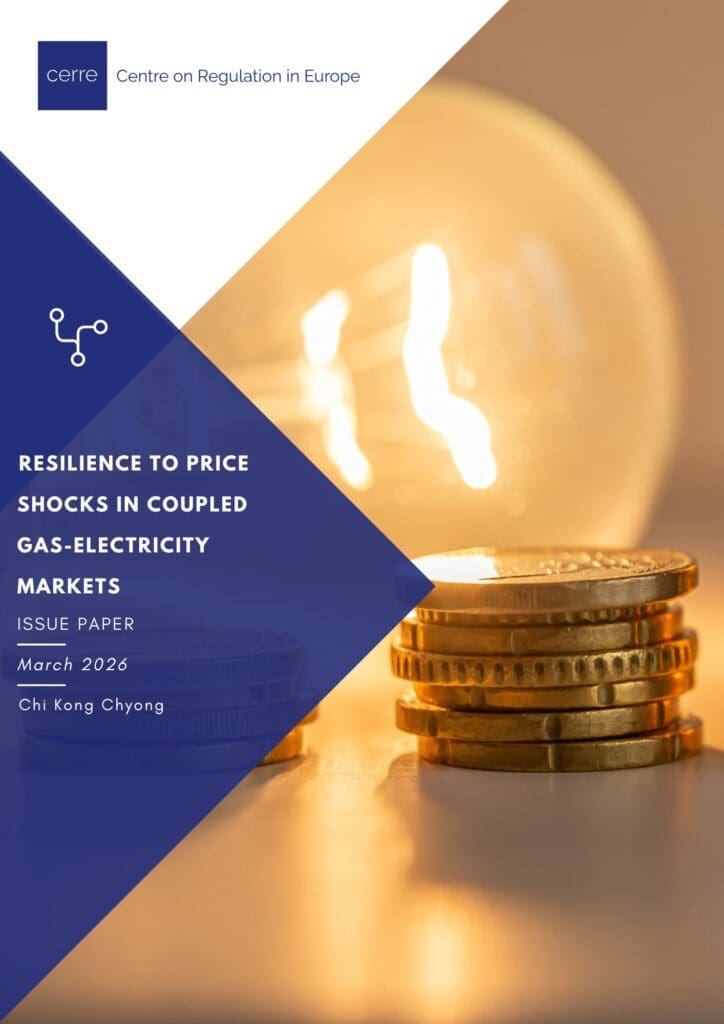
​Resilience to Price Shocks in Coupled Gas-Electricity Markets 

  • March 3, 2026
Share.
Read the Issue Paper "​Resilience to Price Shocks in Coupled Gas-Electricity Markets"

This CERRE paper analyses the interlinkages between European gas and electricity markets and examines how price shocks propagate across the two systems.

Kong Chyong argues that high-impact, low-probability events, including periods of LNG supply stress, can generate severe price volatility, particularly under compound gas-power conditions, and that growing global gas-market integration allows external shocks to transmit rapidly into Europe’s wholesale electricity prices.

The paper suggests that many 2021–23 crisis measures functioned mainly as ex-post coping mechanisms, whereas stronger resilience depends on ex-ante measures that reduce exposure and dampen amplification, including demand-side flexibility, diversification, storage governance, and procurement and long-term contract design.

To support policy-makers in strengthening energy system resilience, the paper proposes an Energy Price Resilience (EPR) metric. Building on the existing gas n-1 security standard and electricity adequacy assessments, the EPR would better capture spillover effects between gas and electricity markets under market stress, including exposure to global LNG supply volatility.

This CERRE paper is a contribution to the renewed debate on electricity market design. It concludes that most research finds the current framework to have proven resilient during the 2021–23 energy crisis and to remain the most efficient mechanism for dispatch and investment.

Document(s)
Read the Issue Paper "​Resilience to Price Shocks in Coupled Gas-Electricity Markets"
Resilience To Price Shocks In Coupled Gas Electricity Markets
Read more publications on Calaméo
Author(s)
Loading...
Kong Chyong
Kong Chyong
Research Fellow
and Oxford Institute for Energy Studies

Dr. Kong Chyong is an applied energy economist and policy analyst with a strong background and more than fifteen years of experience in applications of economics and operational research methods to energy and climate policy questions. Kong’s research interests include economics and geopolitics of Russian natural gas exports, with a focus on Russo-Ukrainian bilateral relations and impacts on Europe and global gas markets. He also works on large-scale modelling of power markets, with a focus on low-carbon generation sources and integration of renewables.

Currently, Kong is a Senior Research Fellow in Energy System Economics and Modelling at the Oxford Institute for Energy Studies. Before this, he was Senior Research Scholar with the Center on Global Energy Policy at Columbia University. Prior to joining Columbia University, Kong was a research associate with the Energy Policy Research Group (EPRG) based at the Cambridge Judge Business School, University of Cambridge. Kong holds a PhD in Energy Economics and Policy (2011) and an MPhil in Technology Policy (2007) from the University of Cambridge. His PhD topic concerned Russia’s strategic natural gas export policy and Gazprom’s pipeline investment strategy.

Prior to his studies at Cambridge University, Kong was a researcher at the at the National Academy of Sciences in Ukraine.

Dr. Kong Chyong is an applied energy economist and policy analyst with a strong background and more than fifteen years of experience in applications of economics and operational research methods to energy and climate policy questions. Kong’s research interests include economics and geopolitics of Russian natural gas exports, with a focus on Russo-Ukrainian bilateral relations and impacts on Europe and global gas markets. He also works on large-scale modelling of power markets, with a focus on low-carbon generation sources and integration of renewables.

Currently, Kong is a Senior Research Fellow in Energy System Economics and Modelling at the Oxford Institute for Energy Studies. Before this, he was Senior Research Scholar with the Center on Global Energy Policy at Columbia University. Prior to joining Columbia University, Kong was a research associate with the Energy Policy Research Group (EPRG) based at the Cambridge Judge Business School, University of Cambridge. Kong holds a PhD in Energy Economics and Policy (2011) and an MPhil in Technology Policy (2007) from the University of Cambridge. His PhD topic concerned Russia’s strategic natural gas export policy and Gazprom’s pipeline investment strategy.

Prior to his studies at Cambridge University, Kong was a researcher at the at the National Academy of Sciences in Ukraine.

More publications

on #Energy & Sustainability

​Perspectives on European Energy Resilience and Policy Alignment 

10 March 2026

Supply Chain Resilience in the Electricity Sector

17 February 2026

Cyber Resilience as a Pillar of European Energy Security

16 December 2025

Updating the Security of Energy Supply Architecture and Preparedness Toolbox for an Increasingly Electrified Energy System

4 November 2025

Embedding Climate Resilience in Regulation

29 October 2025

From Gridlock to Grid Asset: Data Centres for Digital Sovereignty, Energy Resilience, and Competitiveness

30 September 2025

Cross-Border Cost Allocation for Electricity Transmission Networks

24 June 2025

Flexibility in the Energy Sector

27 May 2025

Market Design Options for CCS in Europe: CO2 Transport and Storage Regulation

25 March 2025

Europe’s Pathways to Net Zero: The Role of Renewable Gases and Flexibility

15 October 2024

Stay informed

Subscribe to our newsletter for our latest updates

Subscribe now

Centre on Regulation in Europe asbl (CERRE)

Avenue Louise, 475 (box 10)
1050 Brussels, Belgium
T.: +32 2 230 83 60
E-mail: info@cerre.eu  

Linkedin-in Youtube Link
  • Copyright CERRE 2010-2026
  • BE 0824446055 RPM Bruxelles
About
  • About Us
  • Team
  • Board of Directors
  • Annual review
  • Careers
  • Transparency & Independence
  • FAQs
Expertise
  • Energy, Mobility & Sustainability
  • Tech, Media, Telecom
  • Cross-sector
More
  • Publications
  • Events
  • Blogposts
  • Insights
  • Privacy & Legals
  • Cookie Policy

Centre on Regulation in Europe asbl (CERRE)

Avenue Louise, 475 (box 10)
B-1050 Brussels – Belgium
T.: +3222308360
E-mail: info@cerre.eu 

BE 0824446055 RPM Bruxelles

Linkedin-in Youtube
About
  • About Us
  • Team
  • Board of directors
  • Annual review
  • Careers
  • Transparency & Independence
  • FAQs
Expertise
  • Energy & Sustainability
  • Tech, Media, Telecom
  • Mobility
  • Cross-sector
More
  • Publications
  • Events
  • News & insights
  • Our members
  • Become a member

This website uses cookies to ensure you get the best experience.

OK
CERRE Privacy Policy