Skip to content
CERRE think tank Logo
  • About us
    • About CERRE
    • Our team
    • Board of Directors
    • The CERRE Story
    • Careers
    • Transparency & Independence
    • FAQs
  • Areas of expertise
    • Energy, Mobility & Sustainability
    • Tech, Media, and Telecommunications
    • Cross-sector
  • Publications
    • Ambitions for EU 2024 – 2029
    • Global Governance for the Digital Ecosystems
  • Events
    • Upcoming events
    • Past events
  • Blogposts
  • Insights
  • Media Room
    • Press Releases
    • Press Coverage
  • Membership
    • Our members
    • Become a member
  • Contact
  • About us
    • About CERRE
    • Our team
    • Board of Directors
    • The CERRE Story
    • Careers
    • Transparency & Independence
    • FAQs
  • Areas of expertise
    • Energy, Mobility & Sustainability
    • Tech, Media, and Telecommunications
    • Cross-sector
  • Publications
    • Ambitions for EU 2024 – 2029
    • Global Governance for the Digital Ecosystems
  • Events
    • Upcoming events
    • Past events
  • Blogposts
  • Insights
  • Media Room
    • Press Releases
    • Press Coverage
  • Membership
    • Our members
    • Become a member
  • Contact
Filter by Sectors


Publications
#Tech, Media & Telecom

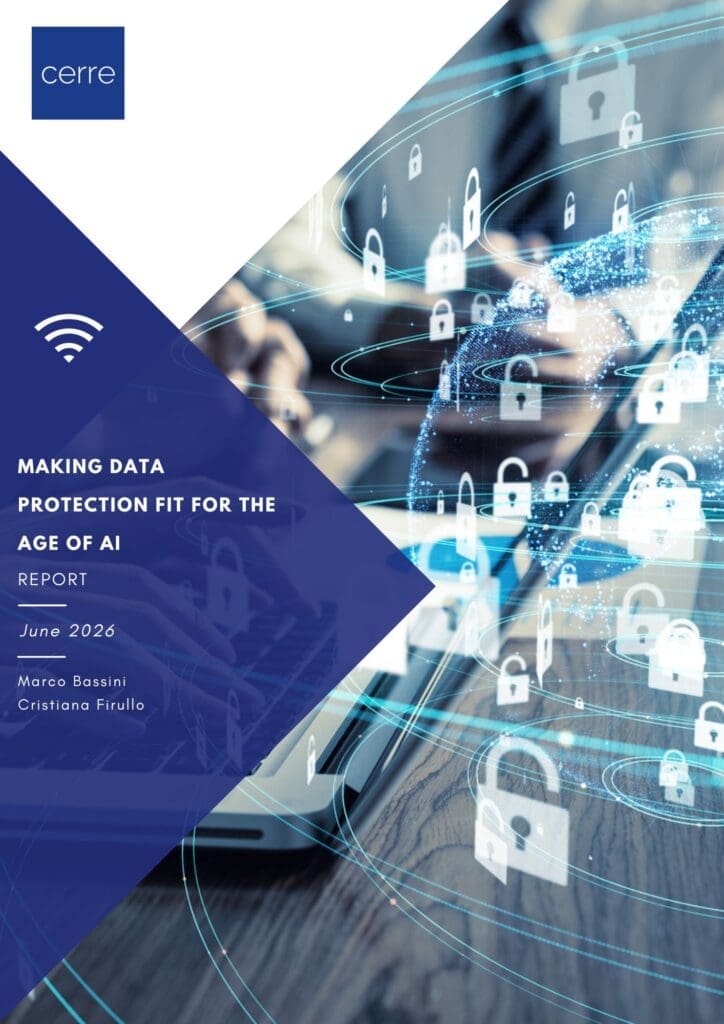
Making Data Protection Fit for the Age of AI

  • June 18, 2026
Share.
Read the Report "Making Data Protection Fit for the Age of AI"

Can the Digital Omnibus make data protection law AI-ready?

As the US and China pour resources into AI, Europe is asking whether its own rulebook helps or hinders. The Digital Omnibus, proposed in November 2025, would recalibrate the EU’s data protection framework, reshaping how firms can build and deploy AI in Europe. Negotiations on the proposal are now underway.

The starting point of this report is that privacy and AI-driven innovation are inherently in conflict. In many settings, from bias mitigation to privacy-enhancing technologies, the interests of users and developers are aligned. The real task is to identify where their interests genuinely diverge.

This paper, by Marco Bassini and Cristiana Firullo, assesses the Omnibus from this starting point and combining legal and economic analysis.

Evaluating the Omnibus

The report concludes that three changes would genuinely strengthen innovation:

  • The Omnibus would provide a clearer legal basis for training AI models. This lifts a major brake on European AI development.
  • It allows organisations to tackle bias across all AI systems, not just the riskiest, allowing firms to build more trustworthy and accurate products.
  • It signals a shift to a more flexible approach to cookies – which (with further reform) could cut friction for businesses and users alike.

Other measures, however, go in the wrong direction, by amending foundational concepts in Europe’s data protection law; ignoring technical feasibility; and risking the current online ecosystem which supports a vast amount of ad-supported free online content.

The report’s authors are cautious that some reforms risk consolidating the position of existing large incumbents (who can tolerate compliance costs) — which could partially offsetting the package’s pro-innovation effects.

Towards a smarter long-term approach

Building on this analysis, the authors set out a three-phase roadmap to ensure Europe’s current focus on competitiveness delivers genuine benefits:

  • Reduce uncertainty: the Omnibus needs to be amended to avoid creating new uncertainties and to preserve GDPR’s foundational concepts.
  • Make the rulebook work as a whole: through the upcoming Digital Fitness Check, ensure the EU’s digital rules are coherent, particularly where data protection meets the AI Act on risk, data governance and responsibilities across the AI life-cycle.
  • Adapt for the long term: over time, move towards a targeted, risk-based application of the GDPR, to better distinguish between data processing that serves users’ interests, and data processing that creates genuine risks to fundamental rights.

The Report will be presented in a CERRE Members only breakfast at the European Parliament on 25 June 2026.

Document(s)
Read the Report "Making Data Protection Fit for the Age of AI"
Making Data Protection Fit for the Age of AILire plus de publications sur Calaméo
Author(s)
Loading...
Marco Bassini (2)
Marco Bassini
Research Fellow
and Tilburg Institute for Law, Technology, and Society – Tilburg University

Marco Bassini is Assistant Professor of Fundamental Rights and Artificial Intelligence at the Tilburg Institute for Law, Technology, and Society – Tilburg University. Previously, he served as adjunct professor of Constitutional Law and Internet Law at Bocconi University, where he also was appointed coordinator for the LLM program in Law of Internet Technology from 2020 to 2022. From 2017 to 2021, he was a postdoctoral researcher at Bocconi University. In 2016 he was a postdoctoral Emile Noël Fellow at New York University and he obtained his PhD in Constitutional Law and European Law from the University of Verona. For over a decade Marco has combined his academic career with legal practice, working at international law firms in Milan and Rome and serving as data protection officer with leading organizations. He also served as external advisor, among others, to the Italian Communications Authority and to the Italian Ministry for Technological Innovation. Marco’s research interests include: protection of human rights in the digital age, regulatory strategies for technology, populism and the Internet.

Marco Bassini is Assistant Professor of Fundamental Rights and Artificial Intelligence at the Tilburg Institute for Law, Technology, and Society – Tilburg University. Previously, he served as adjunct professor of Constitutional Law and Internet Law at Bocconi University, where he also was appointed coordinator for the LLM program in Law of Internet Technology from 2020 to 2022. From 2017 to 2021, he was a postdoctoral researcher at Bocconi University. In 2016 he was a postdoctoral Emile Noël Fellow at New York University and he obtained his PhD in Constitutional Law and European Law from the University of Verona. For over a decade Marco has combined his academic career with legal practice, working at international law firms in Milan and Rome and serving as data protection officer with leading organizations. He also served as external advisor, among others, to the Italian Communications Authority and to the Italian Ministry for Technological Innovation. Marco’s research interests include: protection of human rights in the digital age, regulatory strategies for technology, populism and the Internet.

Cristiana Firullo
Cristiana Firullo
Cornell University and Stanford University

Cristiana Firullo is a PhD Candidate at the Department of Information Science at Cornell University and Visiting Scholar at the Department of Economics at Stanford University. Her research lies at the intersection of economics, behavioural science, and digital platforms, focusing on online user behaviour and digital market design, in particular advertising, algorithmic recommendation systems, and data-driven intermediaries. She combines field experiments, large-scale behavioural data, and theoretical modelling to study how platform design choices affect consumer welfare, market outcomes, and privacy. She is a member of the Internet Behavior Experiment (IBE), a large-scale randomized field experiment on online advertising, tracking, and targeting across browsers, email, and mobile devices. She holds a BSc and MSc in Economics and Social Sciences from Bocconi University, and previously worked at Compass Lexecon (London) and Oxera Consulting LLP (Oxford).

Cristiana Firullo is a PhD Candidate at the Department of Information Science at Cornell University and Visiting Scholar at the Department of Economics at Stanford University. Her research lies at the intersection of economics, behavioural science, and digital platforms, focusing on online user behaviour and digital market design, in particular advertising, algorithmic recommendation systems, and data-driven intermediaries. She combines field experiments, large-scale behavioural data, and theoretical modelling to study how platform design choices affect consumer welfare, market outcomes, and privacy. She is a member of the Internet Behavior Experiment (IBE), a large-scale randomized field experiment on online advertising, tracking, and targeting across browsers, email, and mobile devices. She holds a BSc and MSc in Economics and Social Sciences from Bocconi University, and previously worked at Compass Lexecon (London) and Oxera Consulting LLP (Oxford).

More publications

on #Tech, Media & Telecom

A More Coherent EU Digital Rulebook: Substantive and Institutional Issues

3 June 2026

AI Governance and Geopolitics

27 May 2026

DMA@2: Towards Stronger Governance and Evaluation?

30 April 2026

The role of ‘European preference’ in Europe’s economic strategy

30 April 2026

Transatlantic cooperation on AI and national security

9 April 2026

​Mandating Openness in Regulated Markets 

30 March 2026

DMA Regulatory Interplays

25 February 2026

Towards an EU Consumer Law Fit for the Digital Age

24 February 2026

Assessing and Improving the DMA’s Impact

23 February 2026

Horizontal Interoperability of Social Networking Services

18 February 2026

Stay informed

Subscribe to our newsletter for our latest updates

Subscribe now

Centre on Regulation in Europe asbl (CERRE)

Avenue Louise, 475 (box 10)
1050 Brussels, Belgium
T.: +32 2 230 83 60
E-mail: info@cerre.eu  

Follow and Subscribe

Linkedin-in Youtube Link
  • Copyright CERRE 2010-2026
  • BE 0824446055 RPM Bruxelles
About
  • About Us
  • Team
  • Board of Directors
  • Annual review
  • Careers
  • Transparency & Independence
  • FAQs
Expertise
  • Energy, Mobility & Sustainability
  • Tech, Media, Telecom
  • Cross-sector
More
  • Publications
  • Events
  • Blogposts
  • Insights
  • Privacy & Legals
  • Cookie Policy

Centre on Regulation in Europe asbl (CERRE)

Avenue Louise, 475 (box 10)
B-1050 Brussels – Belgium
T.: +3222308360
E-mail: info@cerre.eu 

BE 0824446055 RPM Bruxelles

Linkedin-in Youtube
About
  • About Us
  • Team
  • Board of directors
  • Annual review
  • Careers
  • Transparency & Independence
  • FAQs
Expertise
  • Energy & Sustainability
  • Tech, Media, Telecom
  • Mobility
  • Cross-sector
More
  • Publications
  • Events
  • News & insights
  • Our members
  • Become a member

This website uses cookies to ensure you get the best experience.

OK
CERRE Privacy Policy