

Skip to content
CERRE think tank Logo
  • About us
    • About CERRE
    • Our team
    • Board of Directors
    • The CERRE Story
    • Careers
    • Transparency & Independence
    • FAQs
  • Areas of expertise
    • Energy, Mobility & Sustainability
    • Tech, Media, and Telecommunications
    • Cross-sector
  • Publications
    • Ambitions for EU 2024 – 2029
    • Global Governance for the Digital Ecosystems
  • Events
    • Upcoming events
    • Past events
  • Blogposts
  • Insights
  • Media Room
    • Press Releases
    • Press Coverage
  • Membership
    • Our members
    • Become a member
  • Contact
  • About us
    • About CERRE
    • Our team
    • Board of Directors
    • The CERRE Story
    • Careers
    • Transparency & Independence
    • FAQs
  • Areas of expertise
    • Energy, Mobility & Sustainability
    • Tech, Media, and Telecommunications
    • Cross-sector
  • Publications
    • Ambitions for EU 2024 – 2029
    • Global Governance for the Digital Ecosystems
  • Events
    • Upcoming events
    • Past events
  • Blogposts
  • Insights
  • Media Room
    • Press Releases
    • Press Coverage
  • Membership
    • Our members
    • Become a member
  • Contact
Filter by Sectors


Publications
#Tech, Media & Telecom

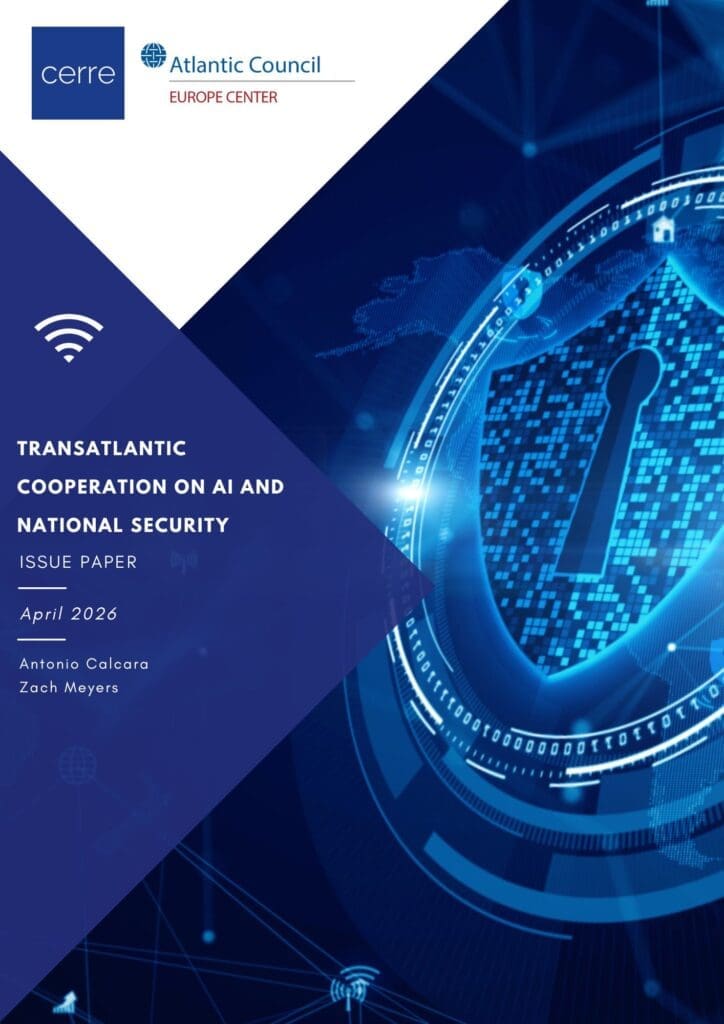
Transatlantic cooperation on AI and national security

  • April 9, 2026
Share.
Read the Issue Paper "Transatlantic cooperation on AI and national security"

Can the EU and US align on AI export controls?

As artificial intelligence becomes central to national security and economic competition, transatlantic co-operation is under growing strain. In the paper ‘AI and National Security’, CERRE Director of Research Zach Meyers and Antonio Calcara, in collaboration with the Atlantic Council, examine how US export controls are shaping Europe’s strategic options.

These developments highlight the close link between AI and national security. While US export controls aim to limit China’s technological progress, they also affect Europe’s ambitions to innovate, enhance its competitiveness, and achieve digital sovereignty. Without more structured co-operation, EU–US relations risk drifting towards “managed interdependence”, marked by asymmetric leverage and ad hoc bargaining rather than strategic alignment.

Three challenges stand out: the unpredictability of US export control policy; EU member-states’ lack of unity in dealing with China; and the limited consideration of allies’ interests in US policy making. Despite these barriers, co-operation remains both possible and necessary. EU–US co-ordination on export controls and sanctions following Russia’s invasion of Ukraine shows that alignment is achievable, even as both sides continue to face shared challenges such as enforcement gaps, circumvention risks, and trade-offs between security and innovation.

Key Recommendations:

  1. The EU and the US should prioritise regular, structured policy dialogue to improve mutual understanding of their respective approaches to AI export controls, reduce the risk of policy surprises, and clarify evolving objectives.
  2. Both sides should develop joint scenario planning and risk assessments to identify AI-related security risks, anticipate potential retaliation, and design more coordinated and effective responses.
  3. The EU and the US should strengthen public–private co-operation to ensure that policies are informed by real-world technological realities, capabilities and risks.

Explore the other papers from the Transatlantic Cooperation Forum: “Transatlantic Cooperation on Protecting Minors Online” and “Improving Transatlantic Cooperation on Digital Competition”.

Document(s)
Read the Issue Paper "Transatlantic cooperation on AI and national security"
Transatlantic Cooperation on AI and National Security
Lire plus de publications sur Calaméo
Author(s)
Loading...
Antonio Calcara 1 768x767
Antonio Calcara
Head, Geopolitics & Technology Programme
Centre for Security, Diplomacy and Strategy (CSDS)

Professor Antonio Calcara is Head of the Geopolitics and Technology Programme at CSDS and a Research Professor at VUB, where he is leading the European Research Council project ‘Competition in the Digital Era’ (CODE): Geopolitics and Technology in the 21st Century’. He holds a PhD in Political Science from LUISS University in Rome. He has previously held academic positions at the University of Antwerp, LUISS University and SciencesPo Paris. He has received research funding from the European Research Council, the Research Foundation – Flanders (FWO), and the European Commission. His research focuses on geopolitical and technological competition in the advanced technology sector. His work has been published in International Security, Security Studies, Review of International Political Economy, Contemporary Security Policy, West European Politics, International Studies Review, Governance, Journal of European Integration and European Security. He is the author of European Defence Decision-Making: Dilemmas of Collaborative Arms Procurement (Routledge).

Professor Antonio Calcara is Head of the Geopolitics and Technology Programme at CSDS and a Research Professor at VUB, where he is leading the European Research Council project ‘Competition in the Digital Era’ (CODE): Geopolitics and Technology in the 21st Century’. He holds a PhD in Political Science from LUISS University in Rome. He has previously held academic positions at the University of Antwerp, LUISS University and SciencesPo Paris. He has received research funding from the European Research Council, the Research Foundation – Flanders (FWO), and the European Commission. His research focuses on geopolitical and technological competition in the advanced technology sector. His work has been published in International Security, Security Studies, Review of International Political Economy, Contemporary Security Policy, West European Politics, International Studies Review, Governance, Journal of European Integration and European Security. He is the author of European Defence Decision-Making: Dilemmas of Collaborative Arms Procurement (Routledge).
Zach Meyers (1)
Zach Meyers
Director of Research

As the CERRE Director of Research, Zach Meyers has a wide remit, including managing our cross-sectoral programmes and projects.

Previously the assistant director of the Centre on European Reform, Zach Meyers has a recognised expertise in economic regulation and network industries such as telecoms, energy, payments, financial services and airports. In addition to advising in the private sector, with more than ten years’ experience as a competition and regulatory lawyer, he has consulted to several governments, regulators and multilateral institutions on competition reforms in regulated sectors. He is also a regular contributor to media.

Zach holds a BA, LLB and a Master of Public & International Law from the University of Melbourne.

As the CERRE Director of Research, Zach Meyers has a wide remit, including managing our cross-sectoral programmes and projects.

Previously the assistant director of the Centre on European Reform, Zach Meyers has a recognised expertise in economic regulation and network industries such as telecoms, energy, payments, financial services and airports. In addition to advising in the private sector, with more than ten years’ experience as a competition and regulatory lawyer, he has consulted to several governments, regulators and multilateral institutions on competition reforms in regulated sectors. He is also a regular contributor to media.

Zach holds a BA, LLB and a Master of Public & International Law from the University of Melbourne.

More publications

on #Tech, Media & Telecom

​Mandating Openness in Regulated Markets 

30 March 2026

DMA Regulatory Interplays

25 February 2026

DMA@2: Towards Stronger Governance and Evaluation?

24 February 2026

Towards an EU Consumer Law Fit for the Digital Age

24 February 2026

Assessing and Improving the DMA’s Impact

23 February 2026

Horizontal Interoperability of Social Networking Services

18 February 2026

Open Tech Platforms: Technology and Governance Mechanisms

10 February 2026

Transatlantic cooperation on protecting minors online

14 January 2026

Charting a European path to competitiveness

8 January 2026

Improving transatlantic cooperation on digital competition

4 December 2025

Stay informed

Subscribe to our newsletter for our latest updates

Subscribe now

Centre on Regulation in Europe asbl (CERRE)

Avenue Louise, 475 (box 10)
1050 Brussels, Belgium
T.: +32 2 230 83 60
E-mail: info@cerre.eu  

Linkedin-in Youtube Link
  • Copyright CERRE 2010-2026
  • BE 0824446055 RPM Bruxelles
About
  • About Us
  • Team
  • Board of Directors
  • Annual review
  • Careers
  • Transparency & Independence
  • FAQs
Expertise
  • Energy, Mobility & Sustainability
  • Tech, Media, Telecom
  • Cross-sector
More
  • Publications
  • Events
  • Blogposts
  • Insights
  • Privacy & Legals
  • Cookie Policy

Centre on Regulation in Europe asbl (CERRE)

Avenue Louise, 475 (box 10)
B-1050 Brussels – Belgium
T.: +3222308360
E-mail: info@cerre.eu 

BE 0824446055 RPM Bruxelles

Linkedin-in Youtube
About
  • About Us
  • Team
  • Board of directors
  • Annual review
  • Careers
  • Transparency & Independence
  • FAQs
Expertise
  • Energy & Sustainability
  • Tech, Media, Telecom
  • Mobility
  • Cross-sector
More
  • Publications
  • Events
  • News & insights
  • Our members
  • Become a member

This website uses cookies to ensure you get the best experience.

OK
CERRE Privacy Policy