

Skip to content
CERRE think tank Logo
  • About us
    • About CERRE
    • Our team
    • Board of Directors
    • The CERRE Story
    • Careers
    • Transparency & Independence
    • FAQs
  • Areas of expertise
    • Energy, Mobility & Sustainability
    • Tech, Media, and Telecommunications
    • Cross-sector
  • Publications
    • Ambitions for EU 2024 – 2029
    • Global Governance for the Digital Ecosystems
  • Events
    • Upcoming events
    • Past events
  • Blogposts
  • Insights
  • Media Room
    • Press Releases
    • Press Coverage
  • Membership
    • Our members
    • Become a member
  • Contact
  • About us
    • About CERRE
    • Our team
    • Board of Directors
    • The CERRE Story
    • Careers
    • Transparency & Independence
    • FAQs
  • Areas of expertise
    • Energy, Mobility & Sustainability
    • Tech, Media, and Telecommunications
    • Cross-sector
  • Publications
    • Ambitions for EU 2024 – 2029
    • Global Governance for the Digital Ecosystems
  • Events
    • Upcoming events
    • Past events
  • Blogposts
  • Insights
  • Media Room
    • Press Releases
    • Press Coverage
  • Membership
    • Our members
    • Become a member
  • Contact
Filter by Sectors


Publications
#Tech, Media & Telecom

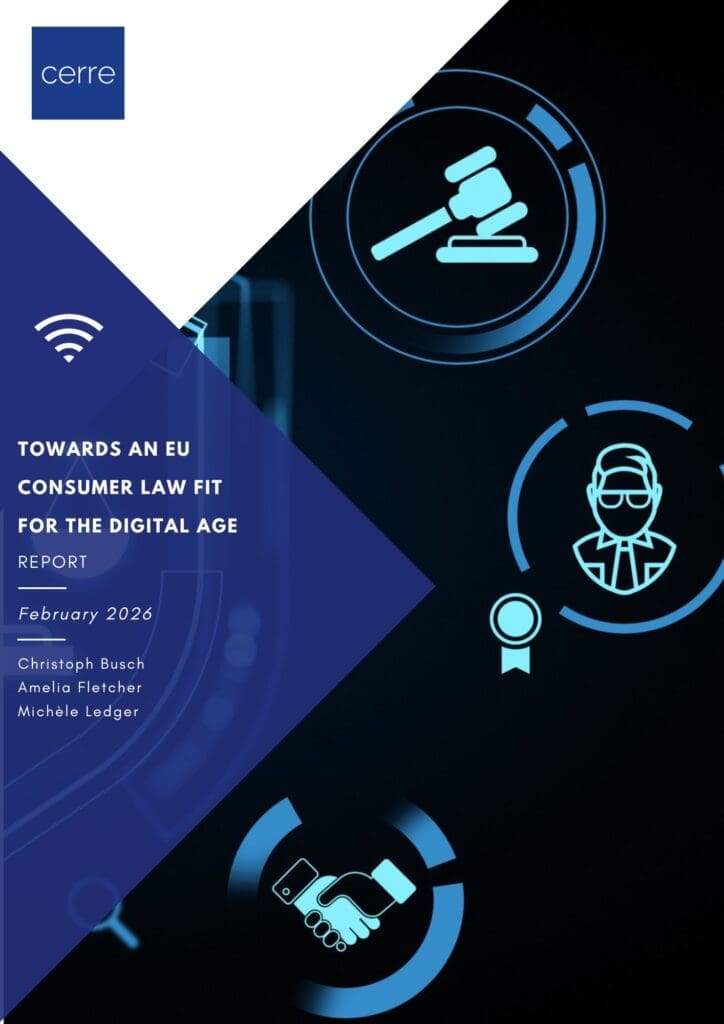
Towards an EU Consumer Law Fit for the Digital Age

  • February 24, 2026
Share.

Designing a Smarter Digital Fairness Act

The European Commission is preparing a proposal for a Digital Fairness Act (DFA), expected later in the year under the 2030 Consumer Agenda. The challenge: to modernise European Union consumer law for the digital age while balancing effective consumer protection with competitiveness and regulatory simplification.

Building on the Digital Fairness Fitness Check, the debate now focuses on how to tackle potential harmful practices – from dark patterns and addictive design to unfair personalisation and the protection of minors – without adding unnecessary complexity or regulatory overlap.

In the CERRE report ‘Towards an EU Consumer Law Fit for the Digital Age’, Christoph Busch, Amelia Fletcher, and Michèle Ledger develop a structured and proportionate framework to guide the design of the forthcoming Digital Fairness Act.

Framework for action

1. Design the DFA on sound regulatory principles

The DFA should focus on genuine regulatory gaps and ensure smooth interaction with existing instruments, particularly the Digital Services Act. It should be grounded in three core principles: risk-based regulation (differentiating by business model and risk profile); design-based regulation (making consumer rights easy to exercise through interface design); and ecosystem regulation (clarifying responsibilities across digital value chains). ‘Fairness by design’ should guide interpretation rather than create unnecessary new layers of obligations.

2. Protect consumers – especially minors – through targeted intervention

Where clear harms arise, the DFA should intervene in a proportionate and risk-based manner. This includes improving fairness in digital subscriptions (for example, easy cancellation), introducing targeted rules on harmful addictive design features, and ensuring stronger, coherent protection of minors – particularly in relation to profiling-based advertising and age assurance. Measures should remain workable for small and medium-sized enterprises and avoid regulatory fragmentation.

3. Address harmful personalisation while preserving benefits

Personalisation might generate value but might also exploit vulnerabilities. The DFA should introduce proportionate safeguards, including a simple opt-out mechanism for personalised advertising, consistency with existing prohibitions on sensitive-data-based and minors’ advertising, and a ban on practices that exploit specific or situational vulnerabilities.

The research was presented on 25 February 2026 at the Digital Platforms Summit 2026.

Document(s)
https://cerre.eu/wp-content/uploads/2026/02/CERRE_Towards-an-EU-Consumer-Law-Fit-for-the-Digital-Age.pdf
Towards an EU Consumer Law Fit For The Digital Age
Read more publications on Calaméo
Author(s)
Loading...
Christoph Busch (3)
Christoph Busch
Research Fellow
and University of Osnabrück

Christoph Busch is Professor of Law and Director of the European Legal Studies Institute at the University of Osnabrück, Germany. He is a Fellow and Council Member of the European Law Institute (ELI) and an Affiliated Fellow at the Information Society Project at Yale University. His research focuses on consumer law, platform governance and algorithmic regulation.

Christoph Busch is Professor of Law and Director of the European Legal Studies Institute at the University of Osnabrück, Germany. He is a Fellow and Council Member of the European Law Institute (ELI) and an Affiliated Fellow at the Information Society Project at Yale University. His research focuses on consumer law, platform governance and algorithmic regulation.

Amelia Fletcher (3)
Amelia Fletcher
Research Fellow
and University of East Anglia

Amelia Fletcher CBE is a Professor of Competition Policy at the Centre for Competition Policy, University of East Anglia and co-editor of the Journal of Competition Law and Economics. She also acts as an expert witness.

She has been a Non-Executive Director at the UK Competition and Markets Authority (2016-2023), Financial Conduct Authority (2013-20) and Payment Systems Regulator (2014-20), and a member of Ofgem’s Enforcement Decision Panel (2014-2022). She has also been a member of DG Comp’s Economic Advisory Group on Competition Policy, and was a member of the Digital Competition Expert Panel, commissioned by the UK Treasury and led by Jason Furman, which reported in March 2019.

She was previously Chief Economist at the Office of Fair Trading (2001-2013), where she also spent time leading the OFT’s Mergers and Competition Policy teams. Before joining the OFT, she was an economic consultant at Frontier Economics (1999-2001) and London Economics (1993-1999).

She has written and presented widely on competition and consumer policy. In her ongoing research, Amelia has a particular interest in the implications for competition and consumer policy of behavioural economics and online markets.

Amelia has a DPhil and MPhil in economics from Nuffield College, Oxford.

Amelia Fletcher CBE is a Professor of Competition Policy at the Centre for Competition Policy, University of East Anglia and co-editor of the Journal of Competition Law and Economics. She also acts as an expert witness.

She has been a Non-Executive Director at the UK Competition and Markets Authority (2016-2023), Financial Conduct Authority (2013-20) and Payment Systems Regulator (2014-20), and a member of Ofgem’s Enforcement Decision Panel (2014-2022). She has also been a member of DG Comp’s Economic Advisory Group on Competition Policy, and was a member of the Digital Competition Expert Panel, commissioned by the UK Treasury and led by Jason Furman, which reported in March 2019.

She was previously Chief Economist at the Office of Fair Trading (2001-2013), where she also spent time leading the OFT’s Mergers and Competition Policy teams. Before joining the OFT, she was an economic consultant at Frontier Economics (1999-2001) and London Economics (1993-1999).

She has written and presented widely on competition and consumer policy. In her ongoing research, Amelia has a particular interest in the implications for competition and consumer policy of behavioural economics and online markets.

Amelia has a DPhil and MPhil in economics from Nuffield College, Oxford.

Portrait of Michele Ledger, CERRE Research Fellow and CRIDS Research Centre of the University of Namur
Michèle Ledger
Research Fellow
and Research Centre in Information, Law and Society (CRIDS), University of Namur

Michèle Ledger is a researcher at the Research Centre in Information, Law and Society (CRIDS) of the University of Namur where she also lectures on the regulatory aspects of online platforms at the postmaster degree course. She has been working for more than twenty years at Cullen International and leads the company’s Media regulatory intelligence service.

Michèle Ledger is a researcher at the Research Centre in Information, Law and Society (CRIDS) of the University of Namur where she also lectures on the regulatory aspects of online platforms at the postmaster degree course. She has been working for more than twenty years at Cullen International and leads the company’s Media regulatory intelligence service.

More publications

on #Tech, Media & Telecom

DMA Regulatory Interplays

25 February 2026

DMA@2: Towards Stronger Governance and Evaluation?

24 February 2026

Assessing and Improving the DMA’s Impact

23 February 2026

Horizontal Interoperability of Social Networking Services

18 February 2026

Open Tech Platforms: Technology and Governance Mechanisms

10 February 2026

Transatlantic cooperation on protecting minors online

14 January 2026

Charting a European path to competitiveness

8 January 2026

Improving transatlantic cooperation on digital competition

4 December 2025

EU Regulation and Institutions for Digital Competitiveness

26 November 2025

The AI Act and Technological Neutrality

25 November 2025

Stay informed

Subscribe to our newsletter for our latest updates

Subscribe now

Centre on Regulation in Europe asbl (CERRE)

Avenue Louise, 475 (box 10)
1050 Brussels, Belgium
T.: +32 2 230 83 60
E-mail: info@cerre.eu  

Linkedin-in Youtube Link
  • Copyright CERRE 2010-2026
  • BE 0824446055 RPM Bruxelles
About
  • About Us
  • Team
  • Board of Directors
  • Annual review
  • Careers
  • Transparency & Independence
  • FAQs
Expertise
  • Energy, Mobility & Sustainability
  • Tech, Media, Telecom
  • Cross-sector
More
  • Publications
  • Events
  • Blogposts
  • Insights
  • Privacy & Legals
  • Cookie Policy

Centre on Regulation in Europe asbl (CERRE)

Avenue Louise, 475 (box 10)
B-1050 Brussels – Belgium
T.: +3222308360
E-mail: info@cerre.eu 

BE 0824446055 RPM Bruxelles

Linkedin-in Youtube
About
  • About Us
  • Team
  • Board of directors
  • Annual review
  • Careers
  • Transparency & Independence
  • FAQs
Expertise
  • Energy & Sustainability
  • Tech, Media, Telecom
  • Mobility
  • Cross-sector
More
  • Publications
  • Events
  • News & insights
  • Our members
  • Become a member

This website uses cookies to ensure you get the best experience.

OK
CERRE Privacy Policy