Skip to content
CERRE think tank Logo
  • About us
    • About CERRE
    • Our team
    • Board of Directors
    • The CERRE Story
    • Careers
    • Transparency & Independence
    • FAQs
  • Areas of expertise
    • Energy, Mobility & Sustainability
    • Tech, Media, and Telecommunications
    • Cross-sector
  • Publications
    • Ambitions for EU 2024 – 2029
    • Global Governance for the Digital Ecosystems
  • Events
    • Upcoming events
    • Past events
  • Blogposts
  • Insights
  • Media Room
    • Press Releases
    • Press Coverage
  • Membership
    • Our members
    • Become a member
  • Contact
  • About us
    • About CERRE
    • Our team
    • Board of Directors
    • The CERRE Story
    • Careers
    • Transparency & Independence
    • FAQs
  • Areas of expertise
    • Energy, Mobility & Sustainability
    • Tech, Media, and Telecommunications
    • Cross-sector
  • Publications
    • Ambitions for EU 2024 – 2029
    • Global Governance for the Digital Ecosystems
  • Events
    • Upcoming events
    • Past events
  • Blogposts
  • Insights
  • Media Room
    • Press Releases
    • Press Coverage
  • Membership
    • Our members
    • Become a member
  • Contact
Filter by Sectors


Publications
#Tech, Media & Telecom

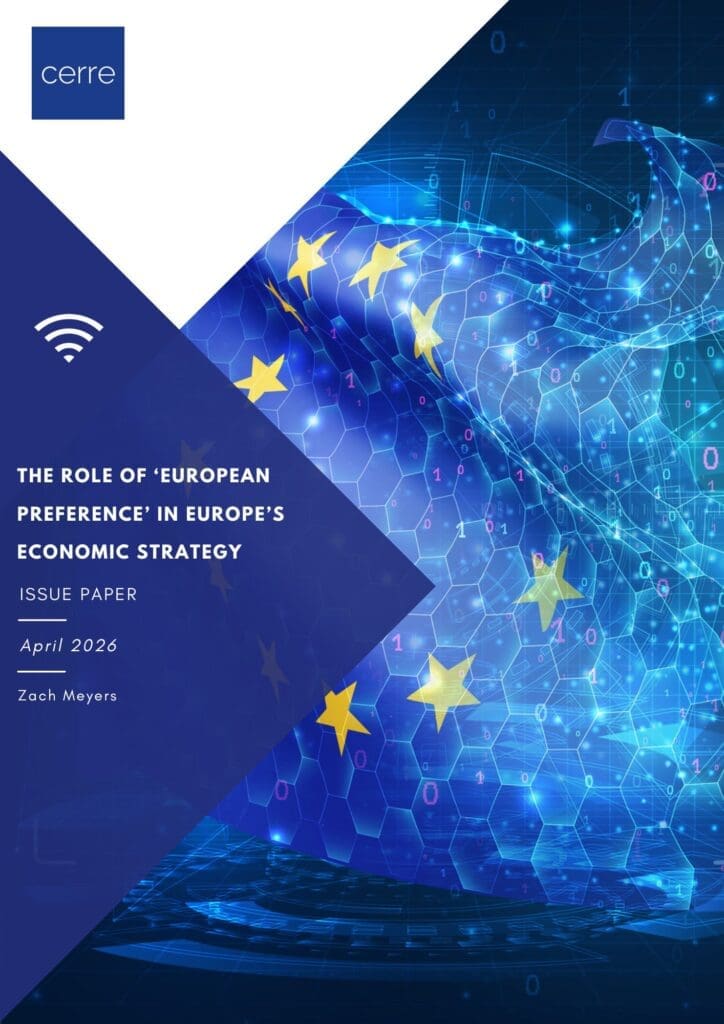
The role of ‘European preference’ in Europe’s economic strategy

  • April 30, 2026
Share.
Read the Issue Paper "The role of ‘European preference’ in Europe’s economic strategy"

When and why a European preference is justified

As China and the US pursue industrial policies to boost domestic manufacturing and cutting-edge innovation, calls for a ‘European preference’ are gaining traction. The Industrial Accelerator Act proposal signals a shift towards a more discerning approach in public procurement and subsidies – and the upcoming Cloud & AI Development Act proposal will likely be a further step along this path.

A well-designed and targeted ‘European preference’ can help deliver important policy goals: boosting resilience, delivering higher economic growth, helping to pry open foreign markets, and better enforcing European values. But it also carries risks: reducing competition, provoking retaliation from trading partners, and facilitating ‘national preferencing’ when the EU desperately needs a genuine single market. For example, most public procurement contracts today go to bidders in the same country as the public authority. So a ‘buy European’ mandate risks not delivering European champions, but only a set of sub-scale national ones.

This paper delivers a framework to help policy-makers clarify when a European preference can deliver results – and how to design it in a way which minimises costs and risks. The paper evaluates strengths and weaknesses of the Industrial Accelerator Act proposal, offering suggestions for how these lessons can be taken on in the Cloud & AI Development Act proposal.

Balancing trade-offs

A key message for policy-makers is that designing a European preference requires tackling trade-offs. Favouring domestic firms can raise costs, weaken competition, and restrict access to leading global technologies, ultimately weighing on productivity and growth. If applied indiscriminately, it can also fragment the single market. Targets must also be chosen in an evidence-based and depoliticised way: otherwise, the EU risks wasting taxpayers’ funds unnecessarily on projects that cannot deliver their objectives.

For these reasons, broad or indiscriminate “buy European” policies are unlikely to deliver. Impact depends on precision: careful targeting, strong governance led by experts and focused on excellence, and a predictable long-term strategy.

Towards a smarter approach

Building on this analysis, CERRE Director of Research Zach Meyers sets out three priorities to ensure any European preference remains effective, targeted, and aligned with wider EU objectives:

  • Match instruments to objectives and time horizons: the most resources should be allocated to early-stage, high-potential ideas which could deliver both economic growth and enhance Europe’s indispensability globally, and which will not require indefinite public support. Some resilience measures may justify longer-term support – but they must remain tightly scoped to clearly identified dependencies.
  • Target market failures: a prerequisite to achieving results is to ensure that European businesses and consumers are not ‘locked in’ to their existing providers. This means reducing barriers to entry and addressing barriers to switching and interoperability. Without these reforms, emerging European companies will struggle to gain customers and scale.
  • Embed preferencing in a broader strategy: effectiveness depends on complementary reforms, deeper capital markets, lower switching costs, a stronger single market and coordination with partners to avoid duplication and retaliation. The EU must also take a stronger and more unified approach to export controls and FDI screening: making sure that when Europe builds an innovative edge, it can maintain it.
Document(s)
Read the Issue Paper "The role of ‘European preference’ in Europe’s economic strategy"
The role of ‘European preference’ in Europe’s economic strategy
Lire plus de publications sur Calaméo
Author(s)
Loading...
Zach Meyers (1)
Zach Meyers
Director of Research

As the CERRE Director of Research, Zach Meyers has a wide remit, including managing our cross-sectoral programmes and projects.

Previously the assistant director of the Centre on European Reform, Zach Meyers has a recognised expertise in economic regulation and network industries such as telecoms, energy, payments, financial services and airports. In addition to advising in the private sector, with more than ten years’ experience as a competition and regulatory lawyer, he has consulted to several governments, regulators and multilateral institutions on competition reforms in regulated sectors. He is also a regular contributor to media.

Zach holds a BA, LLB and a Master of Public & International Law from the University of Melbourne.

As the CERRE Director of Research, Zach Meyers has a wide remit, including managing our cross-sectoral programmes and projects.

Previously the assistant director of the Centre on European Reform, Zach Meyers has a recognised expertise in economic regulation and network industries such as telecoms, energy, payments, financial services and airports. In addition to advising in the private sector, with more than ten years’ experience as a competition and regulatory lawyer, he has consulted to several governments, regulators and multilateral institutions on competition reforms in regulated sectors. He is also a regular contributor to media.

Zach holds a BA, LLB and a Master of Public & International Law from the University of Melbourne.

More publications

on #Tech, Media & Telecom

Transatlantic cooperation on AI and national security

9 April 2026

​Mandating Openness in Regulated Markets 

30 March 2026

DMA Regulatory Interplays

25 February 2026

Towards an EU Consumer Law Fit for the Digital Age

24 February 2026

DMA@2: Towards Stronger Governance and Evaluation?

24 February 2026

Assessing and Improving the DMA’s Impact

23 February 2026

Horizontal Interoperability of Social Networking Services

18 February 2026

Open Tech Platforms: Technology and Governance Mechanisms

10 February 2026

Transatlantic cooperation on protecting minors online

14 January 2026

Charting a European path to competitiveness

8 January 2026

Stay informed

Subscribe to our newsletter for our latest updates

Subscribe now

Centre on Regulation in Europe asbl (CERRE)

Avenue Louise, 475 (box 10)
1050 Brussels, Belgium
T.: +32 2 230 83 60
E-mail: info@cerre.eu  

Follow and Subscribe

Linkedin-in Youtube Link
  • Copyright CERRE 2010-2026
  • BE 0824446055 RPM Bruxelles
About
  • About Us
  • Team
  • Board of Directors
  • Annual review
  • Careers
  • Transparency & Independence
  • FAQs
Expertise
  • Energy, Mobility & Sustainability
  • Tech, Media, Telecom
  • Cross-sector
More
  • Publications
  • Events
  • Blogposts
  • Insights
  • Privacy & Legals
  • Cookie Policy

Centre on Regulation in Europe asbl (CERRE)

Avenue Louise, 475 (box 10)
B-1050 Brussels – Belgium
T.: +3222308360
E-mail: info@cerre.eu 

BE 0824446055 RPM Bruxelles

Linkedin-in Youtube
About
  • About Us
  • Team
  • Board of directors
  • Annual review
  • Careers
  • Transparency & Independence
  • FAQs
Expertise
  • Energy & Sustainability
  • Tech, Media, Telecom
  • Mobility
  • Cross-sector
More
  • Publications
  • Events
  • News & insights
  • Our members
  • Become a member

This website uses cookies to ensure you get the best experience.

OK
CERRE Privacy Policy