Skip to content
CERRE think tank Logo
  • About us
    • About CERRE
    • Our team
    • Board of Directors
    • The CERRE Story
    • Careers
    • Transparency & Independence
    • FAQs
  • Areas of expertise
    • Energy, Mobility & Sustainability
    • Tech, Media, and Telecommunications
    • Cross-sector
  • Publications
    • Ambitions for EU 2024 – 2029
    • Global Governance for the Digital Ecosystems
  • Events
    • Upcoming events
    • Past events
  • Blogposts
  • Insights
  • Media Room
    • Press Releases
    • Press Coverage
  • Membership
    • Our members
    • Become a member
  • Contact
  • About us
    • About CERRE
    • Our team
    • Board of Directors
    • The CERRE Story
    • Careers
    • Transparency & Independence
    • FAQs
  • Areas of expertise
    • Energy, Mobility & Sustainability
    • Tech, Media, and Telecommunications
    • Cross-sector
  • Publications
    • Ambitions for EU 2024 – 2029
    • Global Governance for the Digital Ecosystems
  • Events
    • Upcoming events
    • Past events
  • Blogposts
  • Insights
  • Media Room
    • Press Releases
    • Press Coverage
  • Membership
    • Our members
    • Become a member
  • Contact
Filter by Sectors


Publications
#Energy & Sustainability

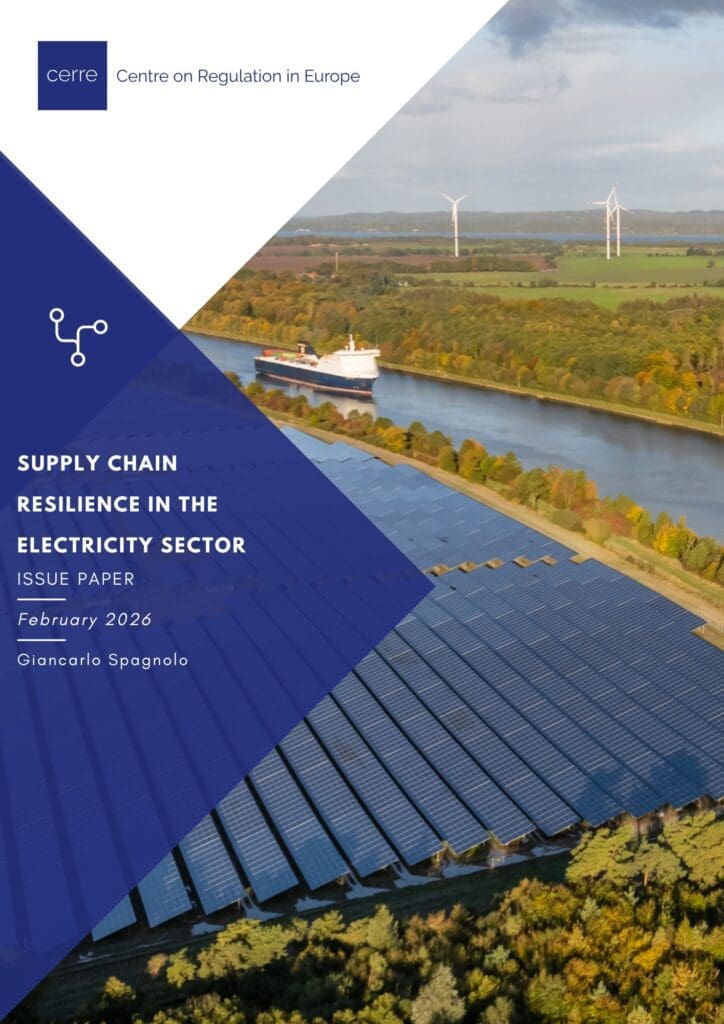
Supply Chain Resilience in the Electricity Sector

  • February 17, 2026
Share.
Read the Issue Paper "Supply Chain Resilience in the Electricity Sector"

Why Electricity Supply Chain Resilience Matters

Against the backdrop of the EU’s broader effort to reduce strategic dependencies in critical industries, this paper examines how public procurement can strengthen supply chain resilience in the European electricity sector. It forms part of CERRE’s ongoing research on the various dimensions of energy-system resilience.

In 2023, the Critical Raw Materials Act and the Net-Zero Industry Act introduced parallel measures to secure access to key inputs and expand European manufacturing capacity in strategic clean technologies. Building on these initiatives, the Industrial Accelerator Act is expected to reinforce the role of public demand in supporting European production and reducing exposure to external shocks. Yet while the regulatory toolbox has expanded, procurement practices remain largely price-driven and insufficiently aligned with long-term resilience objectives.

The electricity sector represents a critical test case. Grid expansion, digitalisation, renewable deployment and electrification depend on complex, globally interconnected supply chains exposed to geopolitical concentration, export controls, cyber risks and production bottlenecks. Diversification is widely recognised as one of the most effective levers to mitigate these risks. In practice, however, diversification is often costly or structurally constrained, as many clean technologies and critical inputs are concentrated in a limited number of countries or suppliers. Without coordinated intervention, contracting authorities may continue to prioritise short-term savings over long-term resilience.

Leveraging Public Procurement for Supply Chain Resilience

The paper argues that public procurement constitutes a central, yet insufficiently structured, instrument for addressing these challenges at the buyer and the contractor level. In view of the upcoming revision of the EU’s public procurement framework, it analyses how procurement rules and public demand can be redesigned to correct structural incentives and embed resilience considerations more systematically. In particular, it examines how procurement frameworks could operationalise:

  • Diversification and multi-sourcing strategies, including contract division into lots, while carefully balancing competition risks and the potential for collusion;
  • Targeted “Buy European” approaches, tailored to highly concentrated strategic technologies and designed to remain compatible with international trade obligations;
  • Public Procurement of Innovation (PPI) and collaborative procurement, to achieve scale, pool expertise and prevent uncoordinated purchasing from aggravating supply bottlenecks;
  • National security screening mechanisms adapted to procurement, enabling the assessment of security risks without removing contracts from the scope of EU procurement law.

A Framework for Measuring and Implementing Resilience in Public Procurement

Beyond procedural design, the paper proposes a structured framework for measuring and implementing supply chain resilience within procurement procedures. It discusses resilience indicators, such as supplier diversification, geopolitical exposure, stockpiling capacity and stress-test performance, and analyses how these can be integrated into selection and award criteria. It further examines how resilience assessments could be centralised through a specialised measurement and certification body, issuing structured resilience ratings that reduce administrative burdens while limiting duplication and free-riding. Particular emphasis is placed on stress tests as ex ante tools to simulate geopolitical or market shocks and to incentivise firms to strengthen their upstream supply chains before disruptions occur.

Document(s)
Read the Issue Paper "Supply Chain Resilience in the Electricity Sector"
Supply Chain Resilience in the Electricity Sector
Read more publications on Calaméo
Author(s)
Loading...
GiancaloSpagnolo AlexSilva Estadao288
Giancarlo Spagnolo
Professor of Economics at the University of Rome Tor Vergata

Giancarlo Spagnolo is Professor of Economics at the University of Rome Tor Vergata and research fellow at EIEF, Rome; CEPR, London; MaCCI, Mannheim; and at SITE -Stockholm School of Economics.

He is an internationally recognised expert on Competition Policy, Public Procurement, and Anti-Corruption. He has published many widely quoted scientific articles in leading international academic journals and has co-edited Cambridge University Press’s Handbook of Procurement and CEPR’s eBook Procurement in Focus: Rules, Discretion, and Emergencies.

He has founded and directed for four years the Research Unit at the Italian Central Procurement Agency (Consip), and has advised many national and international institutions, including the World Bank, the European Parliament, and the European Commission.
Giancarlo Spagnolo is Professor of Economics at the University of Rome Tor Vergata and research fellow at EIEF, Rome; CEPR, London; MaCCI, Mannheim; and at SITE -Stockholm School of Economics.

He is an internationally recognised expert on Competition Policy, Public Procurement, and Anti-Corruption. He has published many widely quoted scientific articles in leading international academic journals and has co-edited Cambridge University Press’s Handbook of Procurement and CEPR’s eBook Procurement in Focus: Rules, Discretion, and Emergencies.

He has founded and directed for four years the Research Unit at the Italian Central Procurement Agency (Consip), and has advised many national and international institutions, including the World Bank, the European Parliament, and the European Commission.

More publications

on #Energy & Sustainability

Cyber Resilience as a Pillar of European Energy Security

16 December 2025

Updating the Security of Energy Supply Architecture and Preparedness Toolbox for an Increasingly Electrified Energy System

4 November 2025

Embedding Climate Resilience in Regulation

29 October 2025

From Gridlock to Grid Asset: Data Centres for Digital Sovereignty, Energy Resilience, and Competitiveness

30 September 2025

Cross-Border Cost Allocation for Electricity Transmission Networks

24 June 2025

Flexibility in the Energy Sector

27 May 2025

Market Design Options for CCS in Europe: CO2 Transport and Storage Regulation

25 March 2025

Europe’s Pathways to Net Zero: The Role of Renewable Gases and Flexibility

15 October 2024

Speeding Up Renewable Energy Permitting in Europe: Overcoming Implementation Challenges

15 October 2024

A Balanced Path to a Net Zero Future: Expansion, Flexibility, Integration and Innovation

15 October 2024

Stay informed

Subscribe to our newsletter for our latest updates

Subscribe now

Centre on Regulation in Europe asbl (CERRE)

Avenue Louise, 475 (box 10)
1050 Brussels, Belgium
T.: +32 2 230 83 60
E-mail: info@cerre.eu  

Linkedin-in Youtube Link
  • Copyright CERRE 2010-2026
  • BE 0824446055 RPM Bruxelles
About
  • About Us
  • Team
  • Board of Directors
  • Annual review
  • Careers
  • Transparency & Independence
  • FAQs
Expertise
  • Energy, Mobility & Sustainability
  • Tech, Media, Telecom
  • Cross-sector
More
  • Publications
  • Events
  • Blogposts
  • Insights
  • Privacy & Legals
  • Cookie Policy

Centre on Regulation in Europe asbl (CERRE)

Avenue Louise, 475 (box 10)
B-1050 Brussels – Belgium
T.: +3222308360
E-mail: info@cerre.eu 

BE 0824446055 RPM Bruxelles

Linkedin-in Youtube
About
  • About Us
  • Team
  • Board of directors
  • Annual review
  • Careers
  • Transparency & Independence
  • FAQs
Expertise
  • Energy & Sustainability
  • Tech, Media, Telecom
  • Mobility
  • Cross-sector
More
  • Publications
  • Events
  • News & insights
  • Our members
  • Become a member

This website uses cookies to ensure you get the best experience.

OK
CERRE Privacy Policy