

Skip to content
CERRE think tank Logo
  • About us
    • About CERRE
    • Our team
    • Board of Directors
    • The CERRE Story
    • Careers
    • Transparency & Independence
    • FAQs
  • Areas of expertise
    • Energy, Mobility & Sustainability
    • Tech, Media, and Telecommunications
    • Cross-sector
  • Publications
    • Ambitions for EU 2024 – 2029
    • Global Governance for the Digital Ecosystems
  • Events
    • Upcoming events
    • Past events
  • Blogposts
  • Insights
  • Media Room
    • Press Releases
    • Press Coverage
  • Membership
    • Our members
    • Become a member
  • Contact
  • About us
    • About CERRE
    • Our team
    • Board of Directors
    • The CERRE Story
    • Careers
    • Transparency & Independence
    • FAQs
  • Areas of expertise
    • Energy, Mobility & Sustainability
    • Tech, Media, and Telecommunications
    • Cross-sector
  • Publications
    • Ambitions for EU 2024 – 2029
    • Global Governance for the Digital Ecosystems
  • Events
    • Upcoming events
    • Past events
  • Blogposts
  • Insights
  • Media Room
    • Press Releases
    • Press Coverage
  • Membership
    • Our members
    • Become a member
  • Contact
Filter by Sectors


Publications
#Tech, Media & Telecom

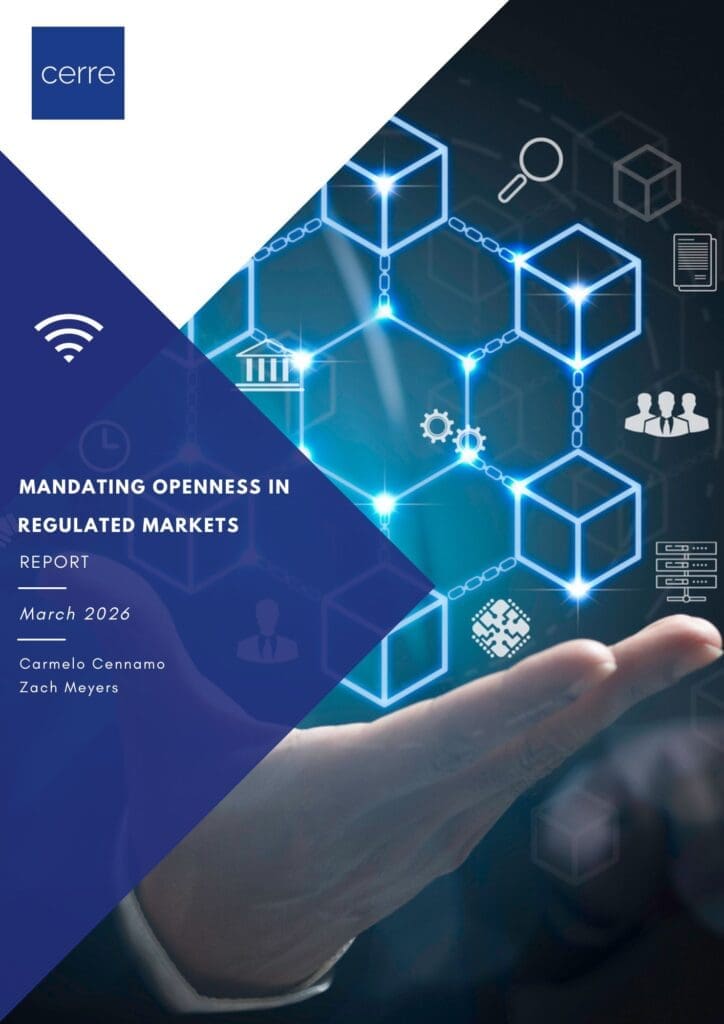
​Mandating Openness in Regulated Markets 

  • March 30, 2026
Share.
Read the Report "Mandating Openness in Regulated Markets"

How open should platforms be?

As Europe seeks to strengthen its competitiveness in digital and high-tech sectors, interoperability – a tool to force platforms to open up their assets so third parties can use them – is increasingly seen as a key policy tool to promote innovation, entry, and consumer choice. Policy makers need to design interoperability in ways which unlock these benefits while avoiding unintended consequences for investment and market dynamics.
In the CERRE report ‘Mandating Openness in Regulated Markets’, Director of Research Zach Meyers and Carmelo Cennamo develop a framework to guide decisions on when and how to mandate interoperability.

Framework for action

  1. Target intervention where bottlenecks persist: Mandated interoperability may be justified where there is a durable bottleneck, often linked to strong network effects or vertical integration, combined with suboptimal competitive dynamics. In most markets, however, competition between platforms already provides incentives for platforms to balance openness and control, limiting the need for regulatory intervention.
  2. Focus interoperability on the right parts of the value chain: Interoperability should be targeted at specific functionalities. Opening peripheral or commoditised elements can foster innovation with limited risk, whereas mandating access to core, differentiating functions has more risk of undermining incentives to invest and innovate.
  3. Calibrate the conditions of access carefully: Interoperability involves trade-offs – interoperability can stimulate generative innovation and entry, but it may sometimes lower the quality of services or reduce investment. ​These trade-offs can be managed by calibrating the conditions under which interoperability is provided.
  4. Ensure effective governance and implementation: Interoperability must be supported by appropriate technical, commercial, and governance mechanisms. Well-designed standards and co-ordination tools are essential to ensure quality, security, and long-term ecosystem development.

A balanced approach to openness

When well designed, interoperability can enable richer ecosystems, lower barriers to entry, and support Europe’s innovation capacity. However, its benefits are highly context-dependent and must be weighed against potential costs, including reduced investment incentives and increased system complexity.
The central policy challenge is therefore to implement interoperability in a proportionate way, maximising benefits for consumers and innovators.
Document(s)
Read the Report "Mandating Openness in Regulated Markets"
Mandating Openness In Regulated Markets
Read more publications on Calaméo
Author(s)
Loading...
Carmelo Cennamo
Carmelo Cennamo
Professor of Strategy and Entrepreneurship
Copenhagen Business School

Carmelo Cennamo is Professor of Strategy and Entrepreneurship at Copenhagen Business School, where he is the Director of the Digital Markets Competition Forum; Affiliate Professor at SDA Bocconi School of Management, where he is the Director of the Platform Economy & Regulation monitor. A frequent keynote speaker in academic and corporate events, he is a leading expert on competition in digital platform markets, and on business ecosystems. On competition policy, Carmelo has provided comments and authored different articles on digital platforms regulation, and was one of the three experts invited by the European Parliament committee on Internal Market and Consumer Protection (IMCO) to review the EU Digital Markets Act.

Carmelo holds a PhD in Strategic Management from IE University, a Master of Science in Economics and BA in Economics and Law from Bocconi University.

Carmelo Cennamo is Professor of Strategy and Entrepreneurship at Copenhagen Business School, where he is the Director of the Digital Markets Competition Forum; Affiliate Professor at SDA Bocconi School of Management, where he is the Director of the Platform Economy & Regulation monitor. A frequent keynote speaker in academic and corporate events, he is a leading expert on competition in digital platform markets, and on business ecosystems. On competition policy, Carmelo has provided comments and authored different articles on digital platforms regulation, and was one of the three experts invited by the European Parliament committee on Internal Market and Consumer Protection (IMCO) to review the EU Digital Markets Act.

Carmelo holds a PhD in Strategic Management from IE University, a Master of Science in Economics and BA in Economics and Law from Bocconi University.

Zach Meyers (1)
Zach Meyers
Director of Research

As the CERRE Director of Research, Zach Meyers has a wide remit, including managing our cross-sectoral programmes and projects.

Previously the assistant director of the Centre on European Reform, Zach Meyers has a recognised expertise in economic regulation and network industries such as telecoms, energy, payments, financial services and airports. In addition to advising in the private sector, with more than ten years’ experience as a competition and regulatory lawyer, he has consulted to several governments, regulators and multilateral institutions on competition reforms in regulated sectors. He is also a regular contributor to media.

Zach holds a BA, LLB and a Master of Public & International Law from the University of Melbourne.

As the CERRE Director of Research, Zach Meyers has a wide remit, including managing our cross-sectoral programmes and projects.

Previously the assistant director of the Centre on European Reform, Zach Meyers has a recognised expertise in economic regulation and network industries such as telecoms, energy, payments, financial services and airports. In addition to advising in the private sector, with more than ten years’ experience as a competition and regulatory lawyer, he has consulted to several governments, regulators and multilateral institutions on competition reforms in regulated sectors. He is also a regular contributor to media.

Zach holds a BA, LLB and a Master of Public & International Law from the University of Melbourne.

More publications

on #Tech, Media & Telecom

DMA Regulatory Interplays

25 February 2026

DMA@2: Towards Stronger Governance and Evaluation?

24 February 2026

Towards an EU Consumer Law Fit for the Digital Age

24 February 2026

Assessing and Improving the DMA’s Impact

23 February 2026

Horizontal Interoperability of Social Networking Services

18 February 2026

Open Tech Platforms: Technology and Governance Mechanisms

10 February 2026

Transatlantic cooperation on protecting minors online

14 January 2026

Charting a European path to competitiveness

8 January 2026

Improving transatlantic cooperation on digital competition

4 December 2025

EU Regulation and Institutions for Digital Competitiveness

26 November 2025

Stay informed

Subscribe to our newsletter for our latest updates

Subscribe now

Centre on Regulation in Europe asbl (CERRE)

Avenue Louise, 475 (box 10)
1050 Brussels, Belgium
T.: +32 2 230 83 60
E-mail: info@cerre.eu  

Linkedin-in Youtube Link
  • Copyright CERRE 2010-2026
  • BE 0824446055 RPM Bruxelles
About
  • About Us
  • Team
  • Board of Directors
  • Annual review
  • Careers
  • Transparency & Independence
  • FAQs
Expertise
  • Energy, Mobility & Sustainability
  • Tech, Media, Telecom
  • Cross-sector
More
  • Publications
  • Events
  • Blogposts
  • Insights
  • Privacy & Legals
  • Cookie Policy

Centre on Regulation in Europe asbl (CERRE)

Avenue Louise, 475 (box 10)
B-1050 Brussels – Belgium
T.: +3222308360
E-mail: info@cerre.eu 

BE 0824446055 RPM Bruxelles

Linkedin-in Youtube
About
  • About Us
  • Team
  • Board of directors
  • Annual review
  • Careers
  • Transparency & Independence
  • FAQs
Expertise
  • Energy & Sustainability
  • Tech, Media, Telecom
  • Mobility
  • Cross-sector
More
  • Publications
  • Events
  • News & insights
  • Our members
  • Become a member

This website uses cookies to ensure you get the best experience.

OK
CERRE Privacy Policy