

Skip to content
CERRE think tank Logo
  • About us
    • About CERRE
    • Our team
    • Board of Directors
    • The CERRE Story
    • Careers
    • Transparency & Independence
    • FAQs
  • Areas of expertise
    • Energy, Mobility & Sustainability
    • Tech, Media, and Telecommunications
    • Cross-sector
  • Publications
    • Ambitions for EU 2024 – 2029
    • Global Governance for the Digital Ecosystems
  • Events
    • Upcoming events
    • Past events
  • Blogposts
  • Insights
  • Media Room
    • Press Releases
    • Press Coverage
  • Membership
    • Our members
    • Become a member
  • Contact
  • About us
    • About CERRE
    • Our team
    • Board of Directors
    • The CERRE Story
    • Careers
    • Transparency & Independence
    • FAQs
  • Areas of expertise
    • Energy, Mobility & Sustainability
    • Tech, Media, and Telecommunications
    • Cross-sector
  • Publications
    • Ambitions for EU 2024 – 2029
    • Global Governance for the Digital Ecosystems
  • Events
    • Upcoming events
    • Past events
  • Blogposts
  • Insights
  • Media Room
    • Press Releases
    • Press Coverage
  • Membership
    • Our members
    • Become a member
  • Contact
Filter by Sectors


Publications
#Tech, Media, Telecom

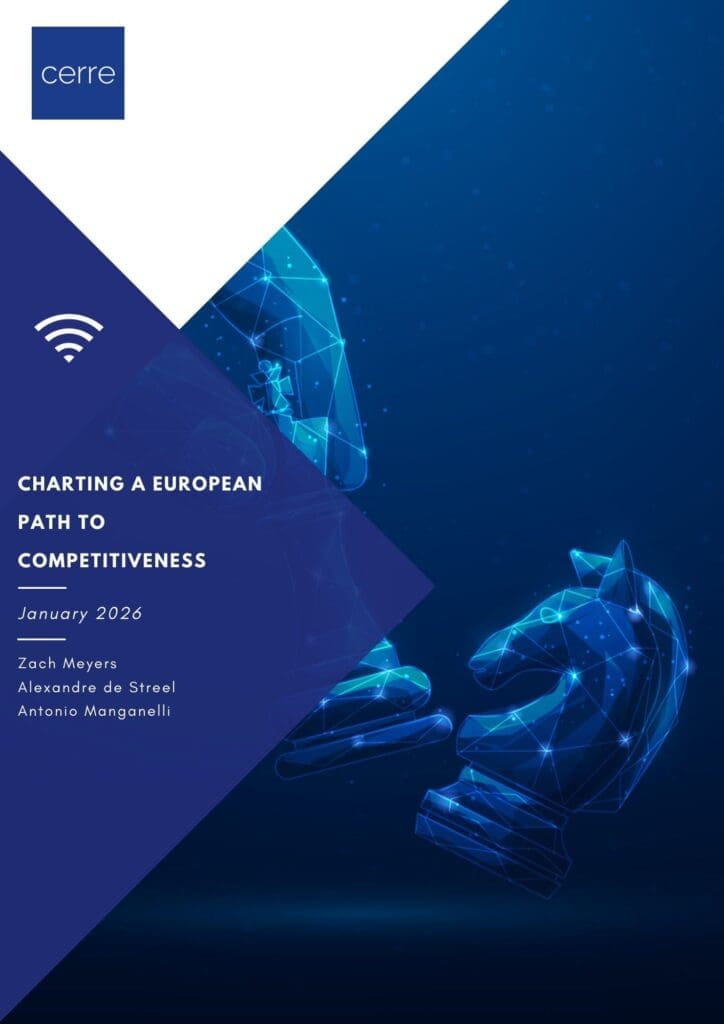
Charting a European path to competitiveness

  • January 8, 2026
Share.
Document(s)
Read the Summary of the Recommendations "Charting a European path to competitiveness"
Read the Book "Charting a European path to competitiveness"

‘​Charting a European path to competitiveness’ reviews Europe’s ongoing efforts to address its twin challenges: enhancing economic competitiveness and securing technological sovereignty. The publication contains three papers which offer a detailed analysis of the progress made, the persistent obstacles encountered, and the policy pathways required to achieve these closely interconnected objectives.

The first paper delves into Europe’s long-standing difficulty in converting its innovative potential into market success, a shortfall that has left the continent overly dependent on foreign technologies. Although competitiveness and sovereignty can mutually reinforce each other in the long term, the paper highlights immediate tensions: on one hand, embracing foreign technology is essential for maintaining productivity and economic growth; on the other, it risks deepening Europe’s strategic dependencies and undermining its autonomy.

The second paper identifies Europe’s significant lag in the adoption and deployment of advanced technologies—such as 5G, cloud computing, and artificial intelligence—as well as the limitations of its capital markets, as the primary drivers of its widening productivity gap, especially in sectors where ICT plays a critical role.

The third paper exposes how Europe’s regulatory and institutional frameworks could be adapted to ease the implementation of growth-oriented reforms. To address these challenges, the paper advocates for the creation of a European Digital Agency, which would streamline digital governance, enhance policy coherence, and improve agility in responding to rapidly evolving technological and economic landscapes.

Key findings from the papers are that there is a fragmented approach to EU digital policy, characterised by a lack of alignment between state aid, trade, competition, and innovation policies. The research cautions against pursuing technological sovereignty through isolationist measures, which could marginalise Europe in the global economy. Instead, it recommends a balanced strategy: protecting or developing strategic or security-sensitive niches, maintaining open markets, and making selective, high-impact investments in sectors where Europe can emerge as a global leader. Institutional reform is identified as a critical enabler for overcoming bureaucratic inertia and creating an environment that fosters innovation and sustainable growth.

Project Context

The research aims to support the development of a competitive, sovereign, and resilient European digital economy. The recommendations emphasise the importance of balanced openness, targeted public investment, and regulatory coherence—principles that are central to CERRE’s vision for a dynamic, inclusive, and globally competitive Europe.

Author(s)
Loading...
Zach Meyers (1)
Zach Meyers
Director of Research

As the CERRE Director of Research, Zach Meyers has a wide remit, including managing our cross-sectoral programmes and projects.

Previously the assistant director of the Centre on European Reform, Zach Meyers has a recognised expertise in economic regulation and network industries such as telecoms, energy, payments, financial services and airports. In addition to advising in the private sector, with more than ten years’ experience as a competition and regulatory lawyer, he has consulted to several governments, regulators and multilateral institutions on competition reforms in regulated sectors. He is also a regular contributor to media.

Zach holds a BA, LLB and a Master of Public & International Law from the University of Melbourne.


As the CERRE Director of Research, Zach Meyers has a wide remit, including managing our cross-sectoral programmes and projects.

Previously the assistant director of the Centre on European Reform, Zach Meyers has a recognised expertise in economic regulation and network industries such as telecoms, energy, payments, financial services and airports. In addition to advising in the private sector, with more than ten years’ experience as a competition and regulatory lawyer, he has consulted to several governments, regulators and multilateral institutions on competition reforms in regulated sectors. He is also a regular contributor to media.

Zach holds a BA, LLB and a Master of Public & International Law from the University of Melbourne.
Alexandre De Streel (2)
Alexandre de Streel
Academic Director
and University of Namur

Alexandre de Streel is CERRE Academic Director, professor of European law at the University of Namur and visiting professor at the College of Europe (Bruges) and SciencesPo Paris. He sits on the scientific committees of the Knight-Georgetown Institute (US), the European University Institute-Centre for a Digital Society (Italy), and the Mannheim Centre for Competition and Innovation (Germany).

His main research areas are regulation and competition policy in the digital economy (telecommunications, platforms, and data) as well as the legal issues raised by the developments of artificial intelligence. He regularly advises the European Union and international organisations on digital regulation.

Previously, Alexandre held visiting positions at New York University Law School, the European University Institute in Florence, Panthéon-Assas (Singapore campus), Barcelona Graduate School of Economics, and the University of Louvain. He also worked for the Belgian Deputy Prime Minister, the Belgian Permanent Representation to the European Union, and the European Commission. He has also been the chair of the expert group on the online platform economy, advising the European Commission.

Alexandre de Streel is CERRE Academic Director, professor of European law at the University of Namur and visiting professor at the College of Europe (Bruges) and SciencesPo Paris. He sits on the scientific committees of the Knight-Georgetown Institute (US), the European University Institute-Centre for a Digital Society (Italy), and the Mannheim Centre for Competition and Innovation (Germany).

His main research areas are regulation and competition policy in the digital economy (telecommunications, platforms, and data) as well as the legal issues raised by the developments of artificial intelligence. He regularly advises the European Union and international organisations on digital regulation.

Previously, Alexandre held visiting positions at New York University Law School, the European University Institute in Florence, Panthéon-Assas (Singapore campus), Barcelona Graduate School of Economics, and the University of Louvain. He also worked for the Belgian Deputy Prime Minister, the Belgian Permanent Representation to the European Union, and the European Commission. He has also been the chair of the expert group on the online platform economy, advising the European Commission.

Antonio Manganelli
Antonio Manganelli
Research Fellow
and University of Siena

Antonio Manganelli is professor of Competition Law and Policy at the University of Siena, where he also obtained his Ph.D. in Law and Economics.

He previously worked at the University of Rome LUMSA as a professor of Antitrust and Regulation, and at the European University Institute, where he was academic coordinator of the Florence School of Regulation.

Antonio has also served in various public institutions in Europe, including the Italian Ministry of Economic Development as Deputy Head of Cabinet, the OECD as a national expert, the Italian Regulator for Telecom, Media and Postal Services (AGCOM), the UK Competition and Markets Authority (CMA), the Office of the Body of European Regulators for Electronic Communications (BEREC), and the Research Office at the Italian Central Bank.

Antonio Manganelli is professor of Competition Law and Policy at the University of Siena, where he also obtained his Ph.D. in Law and Economics.

He previously worked at the University of Rome LUMSA as a professor of Antitrust and Regulation, and at the European University Institute, where he was academic coordinator of the Florence School of Regulation.

Antonio has also served in various public institutions in Europe, including the Italian Ministry of Economic Development as Deputy Head of Cabinet, the OECD as a national expert, the Italian Regulator for Telecom, Media and Postal Services (AGCOM), the UK Competition and Markets Authority (CMA), the Office of the Body of European Regulators for Electronic Communications (BEREC), and the Research Office at the Italian Central Bank.

More publications

on #Tech, Media, Telecom

Improving transatlantic cooperation on digital competition

4 December 2025

EU Regulation and Institutions for Digital Competitiveness

26 November 2025

The AI Act and Technological Neutrality

25 November 2025

Competitiveness, Digital Transformation and EU Policies

20 November 2025

Can the EU reconcile digital sovereignty and economic competitiveness?

15 September 2025

Is the DMA Ready for Agentic AI?

3 July 2025

What policy interventions for a competitive AI sector?

3 July 2025

A Competition Policy for Cloud and AI

17 June 2025

DMA@1: Looking Back and Ahead

26 March 2025

DSA Implementation Forum: Protection of Minors

25 March 2025

Stay informed

Subscribe to our newsletter for our latest updates

Subscribe now

Centre on Regulation in Europe asbl (CERRE)

Avenue Louise, 475 (box 10)
1050 Brussels, Belgium
T.: +32 2 230 83 60
E-mail: info@cerre.eu  

Linkedin-in Youtube Link
  • Copyright CERRE 2010-2026
  • BE 0824446055 RPM Bruxelles
About
  • About Us
  • Team
  • Board of Directors
  • Annual review
  • Careers
  • Transparency & Independence
  • FAQs
Expertise
  • Energy, Mobility & Sustainability
  • Tech, Media, Telecom
  • Cross-sector
More
  • Publications
  • Events
  • Blogposts
  • Insights
  • Privacy & Legals
  • Cookie Policy

Centre on Regulation in Europe asbl (CERRE)

Avenue Louise, 475 (box 10)
B-1050 Brussels – Belgium
T.: +3222308360
E-mail: info@cerre.eu 

BE 0824446055 RPM Bruxelles

Linkedin-in Youtube
About
  • About Us
  • Team
  • Board of directors
  • Annual review
  • Careers
  • Transparency & Independence
  • FAQs
Expertise
  • Energy & Sustainability
  • Tech, Media, Telecom
  • Mobility
  • Cross-sector
More
  • Publications
  • Events
  • News & insights
  • Our members
  • Become a member

This website uses cookies to ensure you get the best experience.

OK
CERRE Privacy Policy