

Skip to content
CERRE think tank Logo
  • About us
    • About CERRE
    • Our team
    • Board of Directors
    • The CERRE Story
    • Careers
    • Transparency & Independence
    • FAQs
  • Areas of expertise
    • Energy, Mobility & Sustainability
    • Tech, Media, and Telecommunications
    • Cross-sector
  • Publications
    • Ambitions for EU 2024 – 2029
    • Global Governance for the Digital Ecosystems
  • Events
    • Upcoming events
    • Past events
  • Blogposts
  • Insights
  • Media Room
    • Press Releases
    • Press Coverage
  • Membership
    • Our members
    • Become a member
  • Contact
  • About us
    • About CERRE
    • Our team
    • Board of Directors
    • The CERRE Story
    • Careers
    • Transparency & Independence
    • FAQs
  • Areas of expertise
    • Energy, Mobility & Sustainability
    • Tech, Media, and Telecommunications
    • Cross-sector
  • Publications
    • Ambitions for EU 2024 – 2029
    • Global Governance for the Digital Ecosystems
  • Events
    • Upcoming events
    • Past events
  • Blogposts
  • Insights
  • Media Room
    • Press Releases
    • Press Coverage
  • Membership
    • Our members
    • Become a member
  • Contact
Filter by Sectors


Publications
#Tech, Media & Telecom

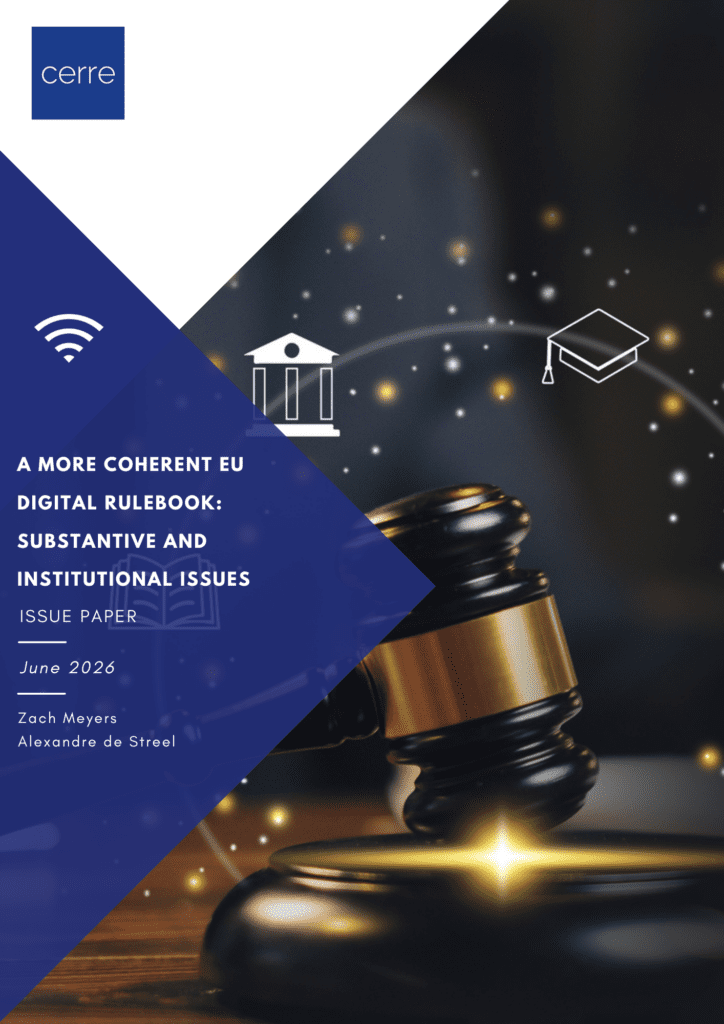
A More Coherent EU Digital Rulebook: Substantive and Institutional Issues

  • June 3, 2026
Share.
Read the Issue Paper "A More Coherent EU Digital Rulebook: Substantive and Institutional Issues"

How to ensure coherence in EU digital regulation?

The EU’s digital rulebook has expanded rapidly in recent years, pursuing multiple objectives, from competition and innovation to consumer protection, cybersecurity, and data protection. While each objective is legitimate, together they often create tensions that are not always addressed well during the policy cycle. This contributes to legal uncertainty, regulatory complexity, and inconsistent outcomes, ultimately affecting firms’ ability to innovate and invest in Europe.

Challenges

In practice, these trade-offs are frequently left unresolved at the legislative stage and are instead managed by public authorities during implementation and enforcement.

At the substantive level, public authorities may struggle because different rules often pursue competing objectives without clearly explaining how they should be balanced. This leaves firms uncertain about how to comply and how regulators will interpret trade-offs, for example, between openness and security or between data protection and data-driven innovation.

At the institutional level, the growing number of authorities involved in digital regulation has created a fragmented landscape. Co-ordination across regulators, both across Member States and across policy domains, remains uneven, increasing the risk of duplication, inconsistent decisions, and reduced regulatory predictability.

Policy directions

Addressing these issues requires action across the regulatory lifecycle. At the legislative stage, there is a need to better identify and confront policy trade-offs upfront, supported by stronger and more dynamic impact assessments. At the enforcement stage, improving co-operation between regulators can help ensure more consistent and predictable outcomes. More broadly, moving towards more principles-based and outcomes-focused approaches can provide greater flexibility to manage competing policy objectives.

A window of opportunity

The European Commission’s ongoing ‘digital fitness check’ offers a timely opportunity to streamline the framework and address inconsistencies. Getting this right will be critical: a more coherent rulebook can reduce uncertainty, unlock innovation, and strengthen Europe’s competitiveness.

In a complex world, trade-offs between regulatory objectives will always exist. The task for Europe is to manage them consistently while giving consumers and businesses clarity and certainty.

Document(s)
Read the Issue Paper "A More Coherent EU Digital Rulebook: Substantive and Institutional Issues"
A More Coherent EU Digital Rulebook: Substantive and Institutional IssuesLire plus de publications sur Calaméo
Author(s)
Loading...
Zach Meyers (1)
Zach Meyers
Director of Research

As the CERRE Director of Research, Zach Meyers has a wide remit, including managing our cross-sectoral programmes and projects.

Previously the assistant director of the Centre on European Reform, Zach Meyers has a recognised expertise in economic regulation and network industries such as telecoms, energy, payments, financial services and airports. In addition to advising in the private sector, with more than ten years’ experience as a competition and regulatory lawyer, he has consulted to several governments, regulators and multilateral institutions on competition reforms in regulated sectors. He is also a regular contributor to media.

Zach holds a BA, LLB and a Master of Public & International Law from the University of Melbourne.

As the CERRE Director of Research, Zach Meyers has a wide remit, including managing our cross-sectoral programmes and projects.

Previously the assistant director of the Centre on European Reform, Zach Meyers has a recognised expertise in economic regulation and network industries such as telecoms, energy, payments, financial services and airports. In addition to advising in the private sector, with more than ten years’ experience as a competition and regulatory lawyer, he has consulted to several governments, regulators and multilateral institutions on competition reforms in regulated sectors. He is also a regular contributor to media.

Zach holds a BA, LLB and a Master of Public & International Law from the University of Melbourne.

Alexandre De Streel (2)
Alexandre de Streel
Academic Director
and University of Namur

Alexandre de Streel is CERRE Academic Director, professor of European law at the University of Namur and visiting professor at the College of Europe (Bruges) and SciencesPo Paris. He sits on the scientific committees of the Knight-Georgetown Institute (US), the European University Institute-Centre for a Digital Society (Italy), and the Mannheim Centre for Competition and Innovation (Germany).

His main research areas are regulation and competition policy in the digital economy (telecommunications, platforms, and data) as well as the legal issues raised by the developments of artificial intelligence. He regularly advises the European Union and international organisations on digital regulation.

Previously, Alexandre held visiting positions at New York University Law School, the European University Institute in Florence, Panthéon-Assas (Singapore campus), Barcelona Graduate School of Economics, and the University of Louvain. He also worked for the Belgian Deputy Prime Minister, the Belgian Permanent Representation to the European Union, and the European Commission. He has also been the chair of the expert group on the online platform economy, advising the European Commission.

Alexandre de Streel is CERRE Academic Director, professor of European law at the University of Namur and visiting professor at the College of Europe (Bruges) and SciencesPo Paris. He sits on the scientific committees of the Knight-Georgetown Institute (US), the European University Institute-Centre for a Digital Society (Italy), and the Mannheim Centre for Competition and Innovation (Germany).

His main research areas are regulation and competition policy in the digital economy (telecommunications, platforms, and data) as well as the legal issues raised by the developments of artificial intelligence. He regularly advises the European Union and international organisations on digital regulation.

Previously, Alexandre held visiting positions at New York University Law School, the European University Institute in Florence, Panthéon-Assas (Singapore campus), Barcelona Graduate School of Economics, and the University of Louvain. He also worked for the Belgian Deputy Prime Minister, the Belgian Permanent Representation to the European Union, and the European Commission. He has also been the chair of the expert group on the online platform economy, advising the European Commission.

More publications

on #Tech, Media & Telecom

AI Governance and Geopolitics

27 May 2026

DMA@2: Towards Stronger Governance and Evaluation?

30 April 2026

The role of ‘European preference’ in Europe’s economic strategy

30 April 2026

Transatlantic cooperation on AI and national security

9 April 2026

​Mandating Openness in Regulated Markets 

30 March 2026

DMA Regulatory Interplays

25 February 2026

Towards an EU Consumer Law Fit for the Digital Age

24 February 2026

Assessing and Improving the DMA’s Impact

23 February 2026

Horizontal Interoperability of Social Networking Services

18 February 2026

Open Tech Platforms: Technology and Governance Mechanisms

10 February 2026

Stay informed

Subscribe to our newsletter for our latest updates

Subscribe now

Centre on Regulation in Europe asbl (CERRE)

Avenue Louise, 475 (box 10)
1050 Brussels, Belgium
T.: +32 2 230 83 60
E-mail: info@cerre.eu  

Follow and Subscribe

Linkedin-in Youtube Link
  • Copyright CERRE 2010-2026
  • BE 0824446055 RPM Bruxelles
About
  • About Us
  • Team
  • Board of Directors
  • Annual review
  • Careers
  • Transparency & Independence
  • FAQs
Expertise
  • Energy, Mobility & Sustainability
  • Tech, Media, Telecom
  • Cross-sector
More
  • Publications
  • Events
  • Blogposts
  • Insights
  • Privacy & Legals
  • Cookie Policy

Centre on Regulation in Europe asbl (CERRE)

Avenue Louise, 475 (box 10)
B-1050 Brussels – Belgium
T.: +3222308360
E-mail: info@cerre.eu 

BE 0824446055 RPM Bruxelles

Linkedin-in Youtube
About
  • About Us
  • Team
  • Board of directors
  • Annual review
  • Careers
  • Transparency & Independence
  • FAQs
Expertise
  • Energy & Sustainability
  • Tech, Media, Telecom
  • Mobility
  • Cross-sector
More
  • Publications
  • Events
  • News & insights
  • Our members
  • Become a member

This website uses cookies to ensure you get the best experience.

OK
CERRE Privacy Policy